
REVIEW · EPHESUS DAY TRIPS
Ephesus and Pamukkale Tours 2 Days 1 Night from Istanbul by plane
Early flights, big ruins, and hot white terraces. This 2-day, 1-night plan bundles door-to-door pickup with internal flights, English-speaking licensed guides, and included entrance fees, so you’re walking famous sites instead of solving Istanbul-to-Ephesus logistics.
I also like the small group size (max 15) and the way guides keep things moving without rushing the key moments. Just be aware the schedule starts very early, and the Cleopatra Pools swim is an add-on with an extra fee.
In This Review
- Key highlights to know before you go
- Price and logistics: what you’re really paying for
- The very early Istanbul pickup and the flight to Izmir
- Meryemana (House of the Virgin Mary): calm context before the crowds
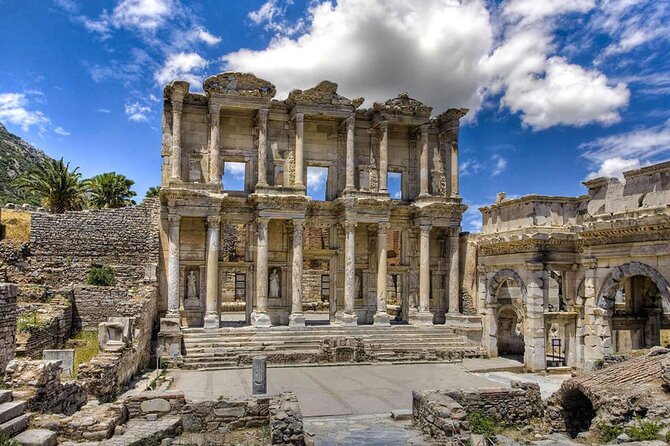
- Ephesus: Celsus, the amphitheater, and the stops that matter
- The Temple of Artemis: history with a built-in wow-factor
- A local handicrafts demonstration (and how to use it well)
- Kusadasi overnight: why it’s a smart base for Ephesus and Pamukkale
- Pamukkale thermal terraces: the white “cotton castle” effect
- Hierapolis UNESCO: spa town ruins with real texture
- Cleopatra Pools add-on: pay if you want the swim
- What a max-15 group feels like on the ground
- Packing and timing tips that make the day easier
- Should you book this Ephesus and Pamukkale tour from Istanbul by plane?
- FAQ
- How long is the tour?
- Is pickup from my hotel included?
- What flights are included?
- Are entrance fees included for the sites?
- Is the tour available in English?
- What group size should I expect?
- Is accommodation included?
- What meals are included?
- How much does Cleopatra Pools cost?
- Can I cancel for a full refund?
Key highlights to know before you go
- Two internal flights (Istanbul → Izmir, Denizli → Istanbul) handled for you, plus airport transfers
- Ephesus in high-impact order: Meryemana, then the big-ticket ruins, then Temple of Artemis
- Historic shrine context at Meryemana (including papal visits in 1967, 1979, and 2006)
- Pamukkale travertines and Hierapolis UNESCO with guided orientation and time to explore
- Max 15 people, English guides, including standout guide names like Timur, Ferhat, and Harun
- Cleopatra Pools costs extra (about 50 Turkish Lira)
More days out to ancient Ephesus


Price and logistics: what you’re really paying for
At $786.04 per person, this is not a budget day trip. But you’re also buying time and problem-solving: flights from Istanbul to Izmir and back from Denizli to Istanbul, transfers, one night in Kusadasi, two lunches, breakfast, and the entrance fees for the main sites listed in the route.
The value feels most obvious on day one. An early pickup gets you to the airport, you do self-check-in with the booking details, and once you land in Izmir, your local team takes over with welcome and transfers. For a trip like Ephesus + Pamukkale, that kind of handoff matters.
Two things to watch: drinks at lunch aren’t included, and Cleopatra Pools swimming is extra.
The very early Istanbul pickup and the flight to Izmir
Your day starts before most people are awake. Pickup is described as early in the morning (around 04:00–04:45), and the plan is built around taking a one-hour flight from Istanbul to Izmir.
This setup does a smart thing: it turns day one from a transit day into a sightseeing day. You land in time to start with Meryemana, then continue straight into Ephesus while the crowds are still settling. It also explains why the day feels full by late afternoon, with a transfer to Kusadasi for your overnight.
If you’re the type who hates rushing, pack patience. You’ll want a small day bag, water, and layers for morning air.
Meryemana (House of the Virgin Mary): calm context before the crowds
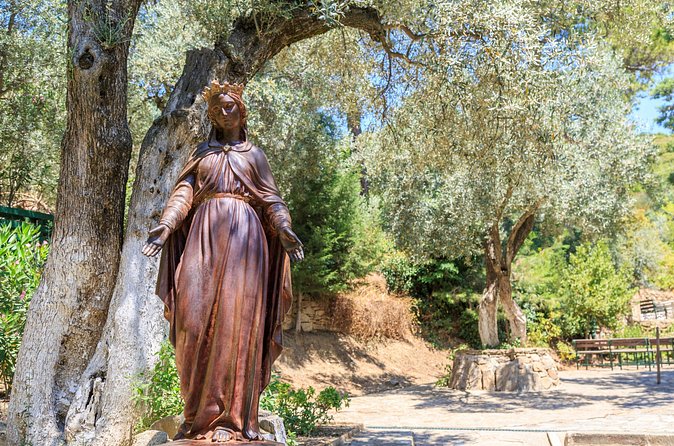
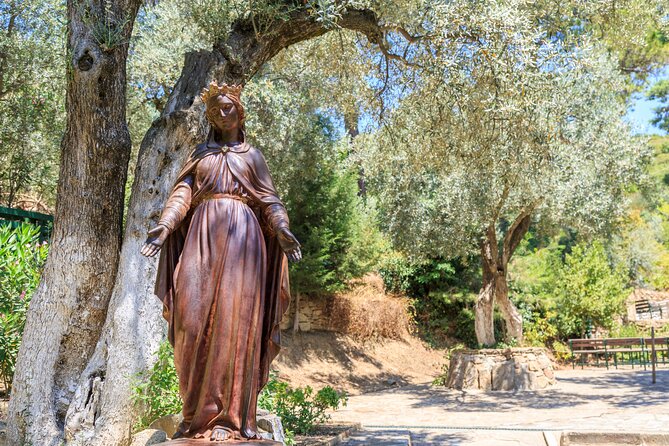
Meryemana, often called the House of the Virgin Mary, is the first major stop on the itinerary. The site is tied to the idea that Mary spent her final years there, and it’s been visited by major religious figures. The plan notes papal visits including Paul VI in 1967, John Paul II in 1979, and Benedict XVI in 2006.
Why this stop works in a fast two-day tour: it’s a slower, reflective pace right before you hit the bigger archaeological zones. You get a guided visit with included time on site, and it’s usually easier to appreciate the atmosphere before the ancient-city crowd flow begins.
Also, the route includes some detail about gifts given during papal visits, so your guide isn’t just pointing at buildings. You’re getting story context as you walk.
More trips to the white terraces of Pamukkale
- 7 Days Best of Turkey Tour: Istanbul-Cappadocia-Ephesus-Pamukkale★ 5.0 · 91 reviews
- 5-Day Aegean Tour – Gallipoli, Troy, Ephesus, Kusadasi, Pamukkale★ 4.5 · 86 reviews
- Istanbul, Ephesus, Pamukkale and Cappadocia 8 Day Package★ 5.0 · 83 reviews
- Private 4 Days Turkey Tour from Istanbul to Cappadocia, Ephesus, Pamukkale★ 5.0 · 80 reviews
Ephesus: Celsus, the amphitheater, and the stops that matter
Ephesus is the reason most people pick this tour, and the route focuses on the parts you’ll remember.
You’ll spend around two hours in the Ancient City of Ephesus with guided orientation and included admission. The highlights listed are the big names and the big experiences:
- The Odeon, known for music concerts
- The Domitian Temple, described as one of the first temples dedicated to a human
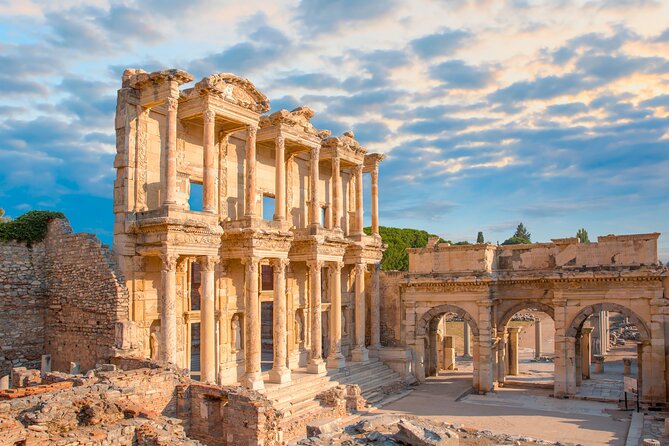
- Celsus Library, called the third biggest library in ancient times
- The Great Amphitheatre, with a capacity noted at 25,000, linked here to St. Paul preaching to the Ephesians
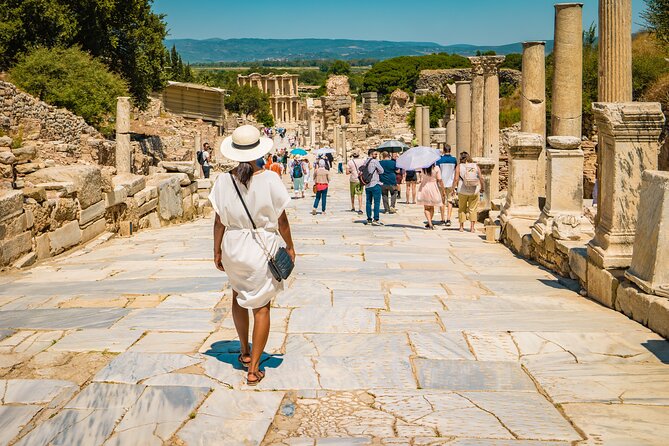
- Marble Street, plus Roman baths, fountains, temples, agora, the Love House area, and public toilets
Here’s the practical angle: a good Ephesus visit isn’t about seeing everything. It’s about seeing the right things in the right order, then having time to look up and take photos without constantly tracking your group.
In the guide style shown by this tour, you can expect crowd-smart timing and clear English explanations that help you understand what you’re standing next to. In past groups, guides named Harun and Ferhat were praised for organizing the day and helping people find good photo spots at the right times.
If you like ruins but hate feeling lost, this kind of guided structure pays off.
The Temple of Artemis: history with a built-in wow-factor
After Ephesus, the route takes you to the Temple of Artemis. This isn’t just a leftover stone stop. The plan gives you the meaning of the site first: Artemis is the Greek goddess, described here as a virginal huntress and twin of Apollo, and tied to the moon through older religious traditions.
The temple’s backstory is also specific. It’s described as being built around 650 BC for the cult of Artemis, financed by a wealthy king of Lydia, and placed on marshy ground as a precaution against future earthquakes.
You’ll have about an hour at this stop with included admission. That’s enough time to get your bearings and understand why the site mattered, even if the structure you see today is only a fragment of the original idea.
If you’re traveling with someone who wants a more spiritual or myth-focused angle alongside archaeology, Artemis is a nice pivot point.
A local handicrafts demonstration (and how to use it well)
Between major ruins, the tour includes a chance to watch a local handicrafts demonstration. You’ll receive educational information while you’re there.
This can be either a meaningful break or a sales stop, depending on how you handle it. The best way to get value here is simple: ask what you’re seeing and how it’s made, and treat it as a cultural pause rather than a shopping obligation. If you’re not in the mood to buy, you can still learn a lot from watching how artisans work.
This is one of the quieter parts of the itinerary, and it helps keep the two-day pace from feeling like a checklist.
Kusadasi overnight: why it’s a smart base for Ephesus and Pamukkale
At the end of day one, you’re transferred to your hotel in Kusadasi and stay overnight. That matters because it removes an extra long drive from your day.
Kusadasi is also where the tour feels most practical. You rest, you reset your energy, and then day two launches toward Pamukkale and Hierapolis early enough to get meaningful time on both sites.
What you should do the night before: confirm where your hotel is, prep comfortable walking shoes, and keep a small stash of snacks and water. The next day’s schedule is active and includes travel by road.
Pamukkale thermal terraces: the white “cotton castle” effect
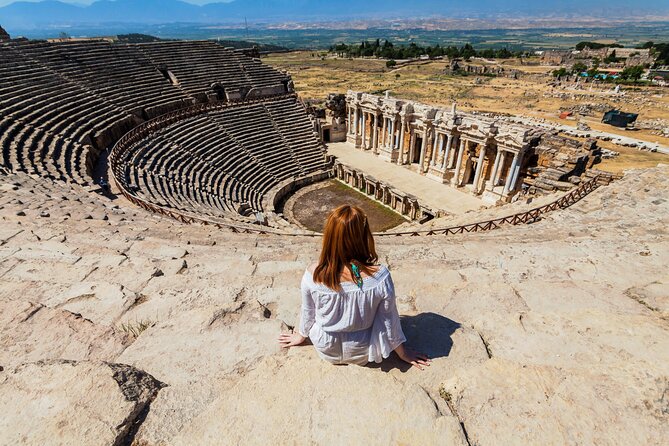
Day two starts with breakfast, then departure around 08:00–08:30. From there, you drive about three hours to Pamukkale for a full-day experience.
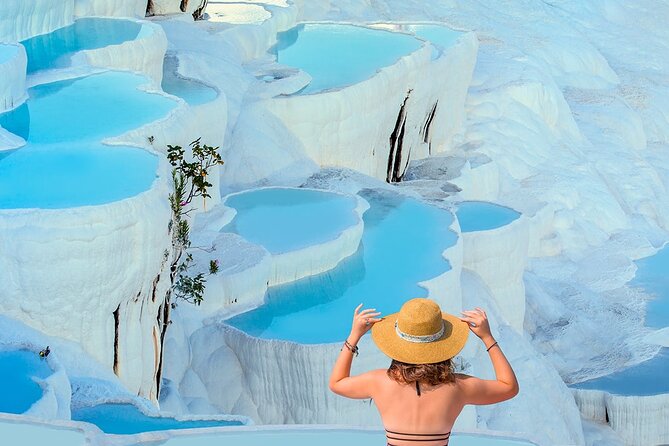
Pamukkale is described as meaning cotton castle in Turkish, and the centerpiece is its hot springs and travertines. Mineral carbonates leave the terraces you see, formed over years of water flow. You’ll get guided explanation first, then time to explore on your own.
You’ll have about 1–2 hours of free time at Pamukkale, and the tour notes swimming in the natural springs as an option, plus exploring the ancient ruins of Hierapolis. That mix is useful in a short trip: you’re not stuck only looking. You can also rest your legs and experience the thermal side of the site.
For photos, timing matters. Mornings often give you softer light, but the tour schedule won’t let you control the sun entirely. Still, having guided context helps you know where the terraces look best before you start snapping.
Hierapolis UNESCO: spa town ruins with real texture
After Pamukkale, the tour shifts to Hierapolis. This area is also UNESCO-listed, and the plan ties it to spa culture going back to the 2nd century BC, when people used the natural sources for treatment.
You’ll have about an hour to explore, and the listed places include a gymnasium, theatre, the Hierapolis City Museum, and the Apollon Temple.
The best way to enjoy Hierapolis in a time-limited visit is to focus on how the site was used, not just what it is. A gymnasium tells you about daily life. A theatre tells you how communities gathered. A temple tells you how belief and power worked together.
If you’ve already enjoyed Ephesus, Hierapolis gives you a different flavor of ancient “public life,” plus the bonus of being literally next to the thermal landscape.
Cleopatra Pools add-on: pay if you want the swim
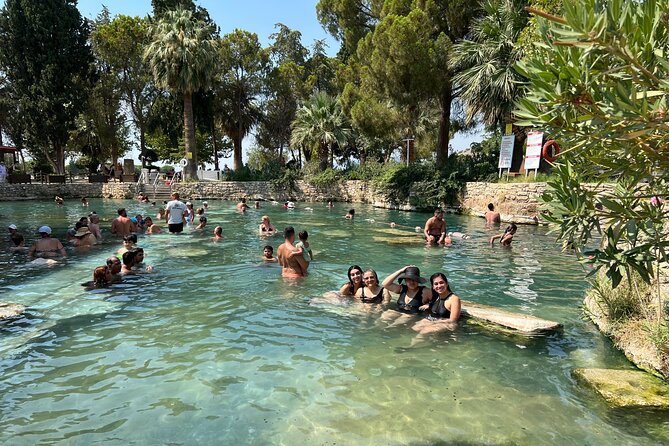
Cleopatra Pools are optional in this tour, and the fee is clearly spelled out. The facility charges an extra cost of about 50 Turkish Lira, stated as roughly €7.5 in one place and around €10 in another.
What’s special here is the combination of natural springs and ancient pillars. The plan also notes you’ll have free time there to swim.
Should you pay? If you care about one last thermal pool experience and don’t mind paying for it, it’s a fun endcap. If you’d rather keep costs down, you can treat Cleopatra Pools as the only missed “extra” rather than a core requirement.
What a max-15 group feels like on the ground
A group of up to 15 can make a big difference. You’re more likely to hear the guide well, move efficiently between stops, and get small-group attention when you need clarification.
This tour is set up for that small-group feel. It also runs in English, and guides like Timur (organization praise), Ferhat (Istanbul guide praise), and Harun (Ephesus and Pamukkale guide praise) show up in examples tied to clear explanations and good crowd navigation.
The practical takeaway for you: you’ll get a structured route and won’t spend the day bargaining with uncertainty. That’s the real reason tours like this get strong recommendations—people want their time in Turkey to be guided, not improvised.
Packing and timing tips that make the day easier
This route asks a lot from your legs. Ephesus and Hierapolis are walking-heavy, and Pamukkale has uneven ground and areas that feel slippery near water.
I’d plan on:
- comfortable walking shoes with good grip
- a light rain jacket or wind layer for early morning
- a small towel or quick-dry items if you plan to swim at Pamukkale or Cleopatra Pools
- sunscreen and water (you’ll be outside for long stretches)
Timing-wise, remember you’ll get free time inside specific stops, but you still want to be back on time for the group. The itinerary is designed around airport windows, transfer times, and included admissions.
Should you book this Ephesus and Pamukkale tour from Istanbul by plane?
If you want Ephesus plus Pamukkale in a tight 2-day window with flights and transfers handled, this tour is a strong fit. The included items do real work for your budget: two internal flights, one night in Kusadasi, English guidance, and entrance fees for the main sites. You’re buying a clear path, not just a list of attractions.
I’d skip it if you hate early starts, dislike structured schedules, or want a slower pace with lots of downtime. Also factor in the optional Cleopatra Pools fee if you’re trying to keep total spending predictable.
If your priority is maximum Turkey payoff with minimal planning stress, this is the kind of trip that can work beautifully.
FAQ
How long is the tour?
The tour is listed as lasting about 2 days (with a 1-night stay).
Is pickup from my hotel included?
Yes. You’re picked up early from your Istanbul hotel and transferred to the airport. Airport transfers are included throughout the trip.
What flights are included?
Flights are included from Istanbul to Izmir, and from Denizli back to Istanbul.
Are entrance fees included for the sites?
Yes. Entrance fees to the museums and sites mentioned in the itinerary are included, while Cleopatra Pools is not included.
Is the tour available in English?
Yes, the tour is offered in English.
What group size should I expect?
The tour has a maximum of 15 travelers.
Is accommodation included?
Yes. The package includes 1 night of accommodation.
What meals are included?
Breakfast is included, and lunch is included twice. Drinks during lunch are not included.
How much does Cleopatra Pools cost?
Cleopatra Pools costs an additional fee of 50 Turkish Lira (around €7.5) to swim there, and it is also listed as around €10 per person.
Can I cancel for a full refund?
Yes, free cancellation is available if you cancel up to 24 hours in advance for a full refund.
More Tour Reviews in Istanbul
- Istanbul: Bosphorus Dinner Cruise & Show with Private Table★ 4.8 · 62,058 reviews
- Istanbul: Daytime or Sunset Sightseeing Cruise & Audio Guide★ 4.8 · 14,430 reviews
- Istanbul: Bosphorus Dinner Cruise & Turkish Night Show★ 4.8 · 12,954 reviews
- Best of Istanbul 1, 2 or 3-Day Private Guided Istanbul Tour★ 5.0 · 8,922 reviews
- Istanbul: Basilica Cistern Fast-Track Entry and Audio Guide★ 4.6 · 7,521 reviews
- Istanbul: Hagia Sophia Skip-the-Line Ticket & Museum Option★ 3.7 · 4,958 reviews
More Trips to Pamukkale
- 4 Days Turkey Tour – Cappadocia, Ephesus and Pamukkale Tour★ 5.0 · 138 reviews
- 6 Days Turkey Tour Cappadocia, Pamukkale, Ephesus, Gallipoli Troy★ 5.0 · 109 reviews
- 7 Days Best of Turkey Tour: Istanbul-Cappadocia-Ephesus-Pamukkale★ 5.0 · 91 reviews
- 5-Day Aegean Tour – Gallipoli, Troy, Ephesus, Kusadasi, Pamukkale★ 4.5 · 86 reviews
- Istanbul, Ephesus, Pamukkale and Cappadocia 8 Day Package★ 5.0 · 83 reviews
- Private 4 Days Turkey Tour from Istanbul to Cappadocia, Ephesus, Pamukkale★ 5.0 · 80 reviews
More Days Out to Ephesus
- 4 Days Turkey Tour – Cappadocia, Ephesus and Pamukkale Tour★ 5.0 · 138 reviews
- 6 Days Turkey Tour Cappadocia, Pamukkale, Ephesus, Gallipoli Troy★ 5.0 · 109 reviews
- Daily Ephesus & House of Virgin Mary from Istanbul – Small Group★ 4.0 · 95 reviews
- 7 Days Best of Turkey Tour: Istanbul-Cappadocia-Ephesus-Pamukkale★ 5.0 · 91 reviews
- 5-Day Aegean Tour – Gallipoli, Troy, Ephesus, Kusadasi, Pamukkale★ 4.5 · 86 reviews
- Istanbul, Ephesus, Pamukkale and Cappadocia 8 Day Package★ 5.0 · 83 reviews
Fresh off the boat: new Istanbul reviews
Ephesus Day Trips, compared.
 ★ 5.04 Days Turkey Tour – Cappadocia, Ephesus and Pamukkale TourFrom $1,571138 reviews
 ★ 5.06 Days Turkey Tour Cappadocia, Pamukkale, Ephesus, Gallipoli TroyFrom $2,122109 reviews
 ★ 4.0Daily Ephesus & House of Virgin Mary from Istanbul – Small GroupFrom $86095 reviews
 ★ 5.07 Days Best of Turkey Tour: Istanbul-Cappadocia-Ephesus-PamukkaleFrom $1,71391 reviews
 ★ 4.55-Day Aegean Tour – Gallipoli, Troy, Ephesus, Kusadasi, PamukkaleFrom $1,54386 reviews
 ★ 5.0Istanbul, Ephesus, Pamukkale and Cappadocia 8 Day PackageFrom $1,05083 reviews
 ★ 5.0Private 4 Days Turkey Tour from Istanbul to Cappadocia, Ephesus, PamukkaleFrom $1,90080 reviews
 ★ 5.0Magic Carpet 10 Day Small Group Istanbul Troy Ephesus CappadociaFrom $2,26276 reviews
Browse the lists this tour appears in